Mechanical systems

Sweeping Robot

SKU E2K-STM-SWR

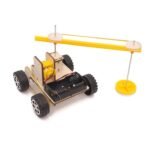
A four-wheeled wooden robot that drives forward and swings its sweeping arm at the same time. One motor turns a gear pair, then two rubber-band belts split the drive: one to the wheels, one to the long arm trailing a plastic disc across the floor.

Grades 6-8 Intermediate 60–75 min build
Original price was: $12.99.Current price is: $9.99. /kit
One motor, a gear pair and two belt drives running at once
Quantity
  • Grades 6–8 · fits a single class period
  • Broken or missing part? We'll post a replacement
What they'll learn

Four ideas, one robot

The most complete transmission in the range, and all of it left out in the open.

Mechanical transmission

A gear pair takes the drive off the motor shaft.

Systems thinking

Two rubber bands split that drive two ways at once.

Mechanical systems

A turning pulley becomes an arm that sweeps side to side.

Spatial reasoning

Sketch the path the sweeping arm traces in each mode.

Specifications

One robot, down to the last pulley

Finished size, materials and part counts for the build.

Finished size 96 × 100 × 90 mm
Weight 140 g
Materials Wood
Pieces 64 pieces
Country of origin China
Safety & compliance

Do not put small parts in your mouth and patiently guide children to install them.

Certified with CPC. Full printed warnings are supplied in the manual.

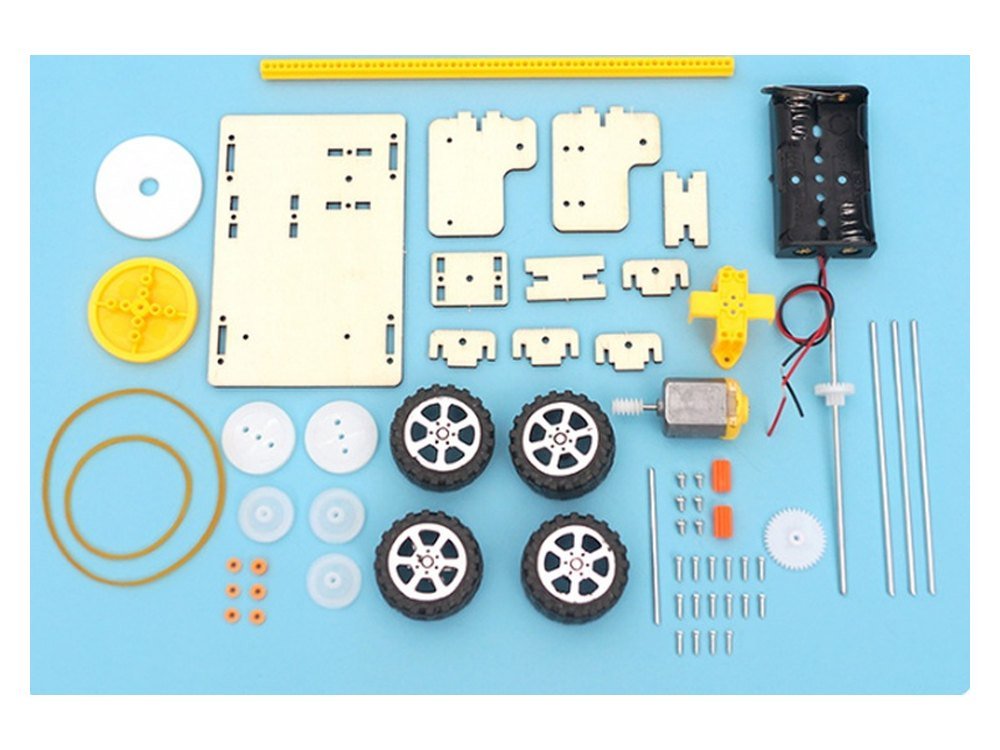
The Sweeping Robot kit as supplied, with every plywood piece, wheel, pulley, gear, band, shaft and the motor laid out
What's in the box

Chassis, wheels, a swing arm and two rubber bands

  • ~15 laser-cut plywood pieces: main board, motor clamps, axle brackets and frame plates
  • 1× DC motor, held in a yellow plastic clip
  • 1× yellow swing rod, 165 mm, and the sweeping disc it carries
  • 1× self-adhesive foam ring, for the face of the disc
  • 3× white pulleys, to be lined up straight
  • Orange and white gears, the gear transmission
  • 2× rubber bands, long and short, one for each belt drive
  • 4× wheels
  • 5× iron shafts with 6× orange retaining rings
  • 1× battery box for 2 AA cells, with a knife switch
  • 22× screws in two lengths, 7 mm and 4 mm
  • 1× illustrated English manual, 16 steps

You'll need to supply: 2 × AA batteries, a small Phillips screwdriver and a ruler. This is the only kit in our range that asks for a measuring tool. Several steps call for exact distances, down to a 0.5 mm clearance behind one gear, and the manual lists over-tight assembly as one of only three reasons the robot won't run. No glue is needed at any point in the build.

How this build works

See mechanics in motion

Build the model, set it loose, and understand the science by watching it work.

Build

Around fifteen plywood pieces across sixteen steps, in two screw sizes. Keep the ruler to hand, because several steps specify exact clearances.

Play

Fit two AA cells, close the knife switch, and it sets off with the arm sweeping alongside it.

Experiment

Fit the head shaft to the pulley and the arm tracks a fixed circle. Take it off and it sweeps freely. Same robot, two behaviors.

Where to start

Master the basics first

Work your way up. Each completed kit unlocks the know-how for your next challenge.

Start here
Doodle Robot
Grades 3–5
7 steps
Then this
Sweeping Robot
Grades 3–5
16 steps
Finish here
Balancing Robot
Grades 3–5
29 steps
Curriculum alignment

Educator & Procurement Resources

Essential information for classroom integration and school purchasing.

Every kit starts as a box of parts and turns into something kids can actually use. Making that happen means following directions and fixing mistakes along the way. They're tackling real engineering challenges, but to them, it just feels like play.
Product safety
Children's Product Certificate (CPC)
Certified to US children's product safety requirements
Run the robot in free mode on a hard floor and sketch the path its sweeping arm traces. Fit the head shaft to the pulley to switch it to circle mode, predict how the path will change, and run it again. Finish with the manual's own question: if you were a product engineer, what smart product would you design? What it shows: one motor drives the wheels and the sweeping arm at the same time, through gears and two rubber-band belts.
Whether you're exploring circuits in a science lab, tackling gears in a makerspace, or learning at home on the living room table, these kits fit right in. One quick tip if you're building a whole class set: build one kit yourself first, so you know where students are likely to need a hand.
PC University Distributors, Inc. is the exclusive distribution partner for E2K Robotics STEM kits to schools and educational institutions. From a single classroom to a district-wide rollout, message the team on WhatsApp at 516-596-1500 or email sales@pcuniversity.com, and they will send educational pricing and the full product list.
What educators & parents say

Reviews

Nothing here yet — and we'd rather say so

Verified reviews will appear on this page as soon as the first Sweeping Robots are built at home and in classrooms. We don't carry ratings over from other kits in the range, and we don't publish anything that isn't from a verified buyer.

If you've built this one with your class, we'd like to hear how it went — what worked, what didn't, and what you'd change.

Reviews

There are no reviews yet.

Be the first to review “Sweeping Robot”

Your email address will not be published. Required fields are marked *

Questions, answered

Before you build

No, and it isn't meant to. The sweeping disc is a flat plastic plate with a foam ring on it, dragged along by the swing arm. There are no bristles, no vacuum and nowhere for anything to be collected, so what it does to whatever is in its path is push it aside. This is a machine for understanding how a floor-cleaning robot works, which is exactly how the manual introduces it, and it demonstrates that in a way a sealed appliance never could: every gear, belt and pulley is out in the open where you can watch it turn. Buy it as a transmission lesson, not as a cleaner.
They're set by a single part. Leave the pulley as it is and the arm runs in free working mode, swinging as the robot drives. Fit the head shaft into the pulley and it switches to circulating mode, where the disc is held to a fixed rotating circle instead. Swapping between them takes seconds and needs no tools, which makes it a genuine before-and-after to run in class. The disc height is adjustable too: slide the white pulley up or down its shaft to raise or lower the arm.
It suits grades 3 to 5 and runs to sixteen steps, but treat that number with caution, because this is the most precision-dependent build we make. Steps 7 through 12 ask for a gear set 20 mm along its shaft, a shaft inserted exactly 2 mm, output shafts at 1 cm and 2 cm, a 1 mm gap behind the pulley and 0.5 mm of clearance behind a gear. Get those wrong and the transmission binds and the robot sits still. Nothing here is beyond a careful eight-year-old, but it does reward patience, and it is not the kit to hand someone who wants to be finished in twenty minutes.
The robot itself is 96 × 100 × 90 mm, so it sits comfortably on a desk. The swing arm adds another 165 mm out to one side, which is worth allowing for: the disc trails well clear of the body, and it needs that room to work. Give it a clear stretch of hard floor rather than a crowded tabletop.
2 × AA batteries, a small Phillips screwdriver, and a ruler. The ruler is the one people don't expect, and it isn't optional: several steps are specified in millimeters and there is no way to judge them by eye. No glue and no other tools are needed, and there is no wire stripping or soldering in this build, since the motor connection is made by twisting the bare wire and wrapping it around the terminal.
PC University Distributors, Inc. is the exclusive distribution partner for E2K Robotics STEM kits to schools and educational institutions. Message the team on WhatsApp at 516-596-1500 or email sales@pcuniversity.com for educational pricing, classroom quantities and the full product list.
16-step manual

In English, with a troubleshooting page at the back

Two working modes

Move one shaft and the arm changes behaviour

Schools welcome

Educational pricing through PC University

Before you start

A ruler is needed, not just a screwdriver

Build the transmission, then watch it work

Sixteen steps, one motor, and two belt drives doing different jobs at once.

Sweeping Robot
Grades 6-8 · Intermediate
Original price was: $12.99.Current price is: $9.99.