Energy transfer

Solar Helicopter

SKU E2K-STM-SPH

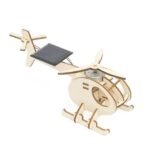
Build a wooden helicopter, stand it in strong sunlight, and the three-blade rotor starts to turn on its own. A 40 mm solar panel on the tail boom wires straight to the motor in the cabin roof, with no battery in between. It is a model that spins, not one that flies.

Grades 3–5 Beginner Glue build, spread across a day
Original price was: $12.99.Current price is: $9.99. /kit
The only kit in the range that runs on nothing but sunlight
Quantity
  • Grades 3–5 · fits a single class period
  • Broken or missing part? We'll post a replacement
Specifications

One box, down to the last shaft sleeve

Finished size, materials and part counts for the build.

Finished size 180 Γ— 70 Γ— 70 mm
Weight 128 g
Materials Wood, with some metal components
Pieces 5 pieces
Country of origin China
Safety & compliance

Do not put small parts in your mouth and patiently guide children to install them.

Certified with CERTIFICATIONACF. Full printed warnings are supplied in the manual.

What they'll learn

Four ideas, one helicopter

All of it comes out of a panel wired straight to a motor, with nothing in between.

Energy transfer

Light lands on the panel and comes out as current.

Input/output

Panel to motor. No battery, no switch, no gears.

Limits of a demonstration

Weak sun or a cold day and the rotor stays still.

Controlled variables

Give each light the same length of time, then compare.

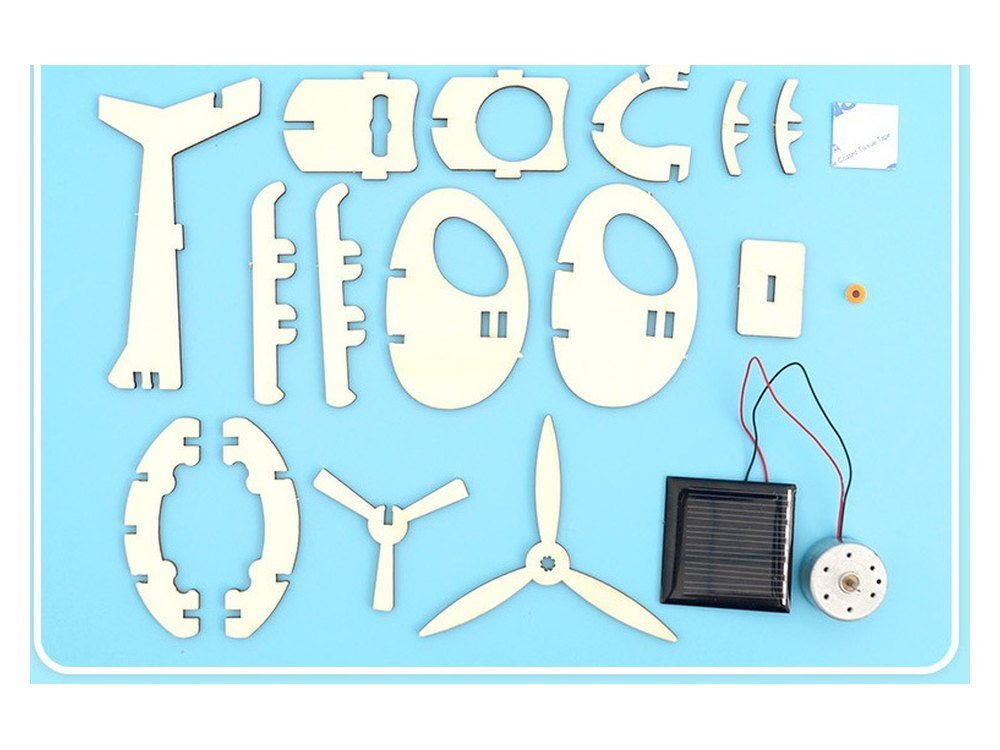
The Solar Helicopter kit as supplied, with every plywood piece, the solar panel, the motor and the rotor laid out
What's in the box

Cabin, tail boom, rotor and a solar panel

  • ~17 laser-cut plywood pieces, numbered ① to ⑬
  • 1× solar panel, 40 × 40 mm
  • 1× DC motor, with two motor clips
  • 1× three-blade rotor, mounted on the motor shaft
  • 1× orange fixing ring, to hold the rotor on
  • 1× double-sided adhesive square, for the panel
  • No screws: the whole model is glued together
  • 1× illustrated English manual, 14 steps

You'll need to supply: PVA wood glue, the sort sold as milky white glue. It is not in the box, and all fourteen steps depend on it, so buy it before you open the kit. The manual asks you to keep it off skin and out of eyes, and to see a doctor if any gets in an eye. Allow ten minutes for each joint to set and more than three hours for the model to cure fully. No batteries and no tools are needed at any point.

How this build works

See mechanics in motion

Build the model, set it loose, and understand the science by watching it work.

Build

Around seventeen plywood pieces across fourteen steps, glued rather than screwed. Ten of those steps use glue, so plan to leave it standing between them.

Play

Stand it outdoors in strong sun, above 15 °C (59 °F), and the rotor begins to turn with nothing switched on.

Experiment

Put a hand over the panel and the rotor stops immediately. Try it under a flashlight indoors and it will not turn at all.

Where to start

Master the basics first

Work your way up. Each completed kit unlocks the know-how for your next challenge.

Start here
Doodle Robot
Grades 3–5
7 steps
Then this
Solar Helicopter
Grades 3–5
14 steps
Finish here
Mechanical T-Rex
Grades 3–5
16 steps
Curriculum alignment

Educator & Procurement Resources

Essential information for classroom integration and school purchasing.

Every kit starts as a box of parts and turns into something kids can actually use. Making that happen means following directions and fixing mistakes along the way. They're tackling real engineering challenges, but to them, it just feels like play.
Product safety
Children's Product Certificate (CPC)
Certified to US children's product safety requirements
Predict which light will spin the rotor: an LED desk lamp, a flashlight or the sun. Point the solar panel at each one for the same length of time and note which ones make the rotor turn. Then, outside on a sunny day above 15 °C (59 °F), cover the panel with your hand and watch what happens. What it shows: the panel powers the motor directly, with no battery in between, so the rotor only turns while strong light falls on the panel.
Whether you're exploring circuits in a science lab, tackling gears in a makerspace, or learning at home on the living room table, these kits fit right in. One quick tip if you're building a whole class set: build one kit yourself first, so you know where students are likely to need a hand.
PC University Distributors, Inc. is the exclusive distribution partner for E2K Robotics STEM kits to schools and educational institutions. From a single classroom to a district-wide rollout, message the team on WhatsApp at 516-596-1500 or email sales@pcuniversity.com, and they will send educational pricing and the full product list.
What educators & parents say

Reviews

Nothing here yet β€” and we'd rather say so

Verified reviews will appear on this page as soon as the first Solar Helicopters are built at home and in classrooms. We don't carry ratings over from other kits in the range, and we don't publish anything that isn't from a verified buyer.

If you've built this one with your class, we'd like to hear how it went β€” what worked, what didn't, and what you'd change.

Reviews

There are no reviews yet.

Be the first to review “Solar Helicopter”

Your email address will not be published. Required fields are marked *

Questions, answered

Before you build

No, and we want to be completely clear about that before you order. This is a display model whose rotor spins. The landing skids are glued to the body, the plywood airframe is heavy for a small motor, and there is no lift mechanism of any kind. Put it in the sun and the rotor turns; that is the whole of what it does. If you are buying for a child who is picturing a helicopter that leaves the table, this is not that product and they will know within seconds.
Direct sunlight, and a reasonably warm day. The manual puts the working threshold at above 15 degrees Celsius with strong sun, and says that below that the panel cannot supply enough power to drive the motor. There is no battery in this model, so there is no reserve to fall back on: the rotor turns while the light is good and stops when it isn't. In a cool or overcast climate that means it will sit still for a good part of the year, which is worth knowing up front.
Not under household lighting. The manual is specific here: a flashlight or an LED lamp will generate a current in the panel, but it is far too weak to turn the motor. That makes a good demonstration in itself, since it shows the difference between producing electricity and producing useful electricity. We haven't yet tested whether a bright windowsill behind glass is enough, so we're not going to claim either way until we have.
The hands-on work is short, but the glue sets the pace. Ten of the fourteen steps use PVA, and the manual asks for ten minutes of setting time between joints and more than three hours to cure fully. Treat it as a build you start in the morning and finish later, or spread over two sessions, rather than something to complete in one sitting. Nothing about the assembly is difficult. The patience is the hard part, and rushing the glue is the one way to end up with a model that comes apart.
PVA wood glue, and only that. The manual lists it as a self-provided material and there is no bottle in the kit, so pick some up before you start, because without it the build cannot begin. Keep it off skin and out of eyes, and see a doctor if any does get in an eye. Beyond the glue you need nothing at all: no batteries, no screwdriver, no tools of any kind.
PC University Distributors, Inc. is the exclusive distribution partner for E2K Robotics STEM kits to schools and educational institutions. Message the team on WhatsApp at 516-596-1500 or email sales@pcuniversity.com for educational pricing, classroom quantities and the full product list.
14-step manual

In English, with a troubleshooting page at the back

No batteries, ever

The only kit in the range powered by sunlight alone

Schools welcome

Educational pricing through PC University

Before you start

PVA wood glue is needed and is not in the box

Stand it in the sun and watch the rotor turn

Fourteen steps, no tools, and a panel wired straight to the motor.

Solar Helicopter
Grades 3–5 Β· Beginner
Original price was: $12.99.Current price is: $9.99.