Energy transfer Mechanical systems

Solar Power Car

SKU E2K-STM-STC

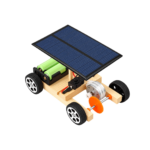
A wooden four-wheeled car with a solar panel on the roof, two rechargeable cells underneath it and a switch in between. In strong sun the panel drives the motor and tops the cells up at the same time. When the light drops, the car runs on what it stored.

Grades 6-8 Intermediate 45–60 min build
Original price was: $12.99.Current price is: $9.99. /kit
Two rechargeable cells included, and the panel recharges them
Quantity
  • Grades 3–5 · fits a single class period
  • Broken or missing part? We'll post a replacement
What they'll learn

Four ideas, one car

The manual opens with a circuit diagram, and the rest of the build follows from it.

Repeatable observations

Check every hour whether it will run again.

Energy transfer

Strong sun drives the motor and charges the cells at once.

Limits of a demonstration

Indoor LED light gives the panel far less power than the sun.

Controlled variables

Repeat the test under LED light for the same length of time.

Specifications

One car, down to the last cable tie

Finished size, materials and part counts for the build.

Finished size 120 × 85 × 90 mm
Weight 166 g
Materials Wood
Pieces 34 pieces
Country of origin China
Safety & compliance

Do not put small parts in your mouth and patiently guide children to install them.

Certified with CPC. Full printed warnings are supplied in the manual.

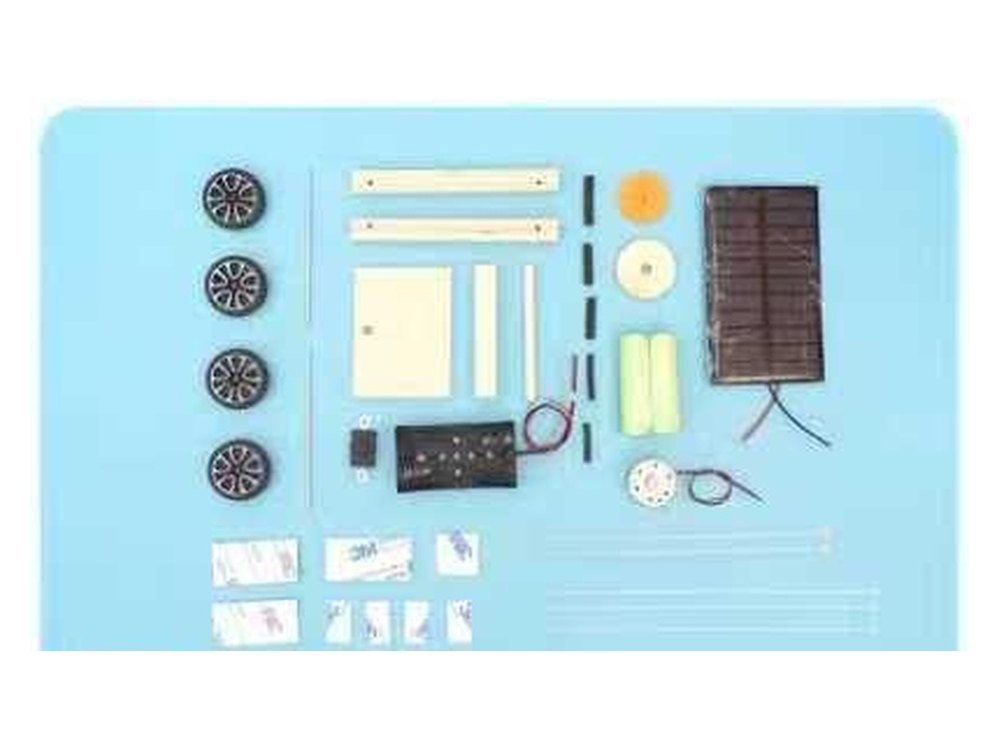
The Solar Power Car kit as supplied, with wheels, timber, the panel, motor, gear, switch and the two rechargeable cells
What's in the box

Deck, wheels, a panel and two rechargeable cells

  • ~6 plywood and timber pieces: deck, side rails, motor support and panel rod
  • 1× solar panel, with a protective film to peel off
  • 2× 1.2 V AA rechargeable cells, 700 mAh
  • 1× battery box, wired into the loop
  • 1× DC motor with a white pinion
  • 1× orange spur gear, for the rear axle
  • 4× wheels and 2× metal axles
  • 1× slide switch, to turn it on and off
  • Heat-shrink tube in 2 mm and 3 mm, for the wire joints
  • Double-sided tape and 20 cm cable ties, in place of screws
  • 1× illustrated English manual, 17 steps, with a circuit diagram

You'll need to supply: a pair of small scissors, for the double-sided tape and the cable ties, and a lighter. The manual calls for the lighter twice: in Step 3 to strip the wires back to a 1 cm core, and in Step 4 to shrink the tubing over the joints. We treat both as adult-only steps, and we are reviewing them with the manufacturer. The batteries are supplied, so there is nothing else to buy.

How this build works

See mechanics in motion

Build the model, set it loose, and understand the science by watching it work.

Build

Seventeen steps and no screws anywhere. The car is held together with double-sided tape and cable ties, with an adult handling the wiring in Steps 3 and 4.

Play

Flick the switch and drive it. Indoors it runs on the two rechargeable cells. Outdoors in strong sun the panel takes over and refills them as it goes.

Experiment

Hold it under an LED lamp and nothing happens. Carry it into full sun and it moves. The manual's own FAQ explains why the two are not the same light.

Where to start

Master the basics first

Work your way up. Each completed kit unlocks the know-how for your next challenge.

Start here
Mechanical T-Rex
Grades 3–5
16 steps
Then this
Solar Power Car
Grades 3–5
17 steps
Finish here
Remote Control Racing Car
Grades 3–5
24 steps
Curriculum alignment

Educator & Procurement Resources

Essential information for classroom integration and school purchasing.

Every kit starts as a box of parts and turns into something kids can actually use. Making that happen means following directions and fixing mistakes along the way. They're tackling real engineering challenges, but to them, it just feels like play.
Product safety
Children's Product Certificate (CPC)
Certified to US children's product safety requirements
Drive the car until it slows to a stop, then switch it off. Leave it with the solar panel facing strong sunlight on a day above 15 °C (59 °F), and check every hour whether it will run again. On another day, repeat the test under classroom LED lights for the same length of time, and compare. What it shows: the panel turns sunlight into electricity and stores it in the car's two rechargeable batteries, and indoor LED light gives the panel far less power than the sun.
Whether you're exploring circuits in a science lab, tackling gears in a makerspace, or learning at home on the living room table, these kits fit right in. One quick tip if you're building a whole class set: build one kit yourself first, so you know where students are likely to need a hand.
PC University Distributors, Inc. is the exclusive distribution partner for E2K Robotics STEM kits to schools and educational institutions. From a single classroom to a district-wide rollout, message the team on WhatsApp at 516-596-1500 or email sales@pcuniversity.com, and they will send educational pricing and the full product list.
What educators & parents say

Reviews

Nothing here yet — and we'd rather say so

Verified reviews will appear on this page as soon as the first Solar Power Cars are built at home and in classrooms. We don't carry ratings over from other kits in the range, and we don't publish anything that isn't from a verified buyer.

If you've built this one with your class, we'd like to hear how it went — what worked, what didn't, and what you'd change.

Reviews

There are no reviews yet.

Be the first to review “Solar Power Car”

Your email address will not be published. Required fields are marked *

Questions, answered

Before you build

Yes, in the right conditions, and it's worth knowing what those are. The manual is specific: strong sunlight and a temperature above about 15 degrees Celsius for the panel to drive the motor outright, and in those conditions it charges the cells at the same time. Below that, the panel doesn't stop working, it just does less: it charges the battery, or assists the motor rather than powering it. So in cool or overcast weather the car still drives, but on stored charge rather than on live sunlight.
The car will, the panel mostly won't. Charge the cells outside and it drives around indoors on stored power for as long as they last. What won't happen indoors is solar driving: household LED lighting will not turn the motor. The manual says a flashlight or LED lamp does generate a current in the panel, but far too little to move the car, and that indoor solar testing needs a tungsten filament lamp above 100 watts, which is a bulb type most homes no longer have. Plan on taking it outside for the solar half of the lesson.
They are, and this is the only kit in our range that ships with them. You get two 1.2 volt AA rechargeable cells at 700 mAh, wired in series so the motor sees 2.4 volts. The manual puts a full charge at about six hours of strong sunlight and rates the cells at around 300 recharge cycles. Nothing else needs buying to make the car run.
It suits grades 3 to 5 and runs to seventeen steps, but the step count understates it. This kit involves real electrical work: stripping wire, joining a circuit, and sealing the joints with heat-shrink tubing. Both of those wiring steps call for a lighter, once to remove the wire covering and once to shrink the tubing, and the kit contains no wire stripper. We treat those as adult jobs, not children's jobs, and we're reviewing them with the manufacturer. With the wiring done, the rest of the build is straightforward taping and fitting.
A pair of small scissors and a lighter, with an adult using the lighter. The scissors cut the double-sided tape and trim the cable ties; the lighter handles Steps 3 and 4. There are no screws in this kit and no screwdriver is needed, because the whole car is held together with tape and ties. Batteries are already supplied.
PC University Distributors, Inc. is the exclusive distribution partner for E2K Robotics STEM kits to schools and educational institutions. Message the team on WhatsApp at 516-596-1500 or email sales@pcuniversity.com for educational pricing, classroom quantities and the full product list.
17-step manual

In English, with a circuit diagram and a troubleshooting page

Batteries included

Two rechargeable cells the roof panel keeps topped up

Schools welcome

Educational pricing through PC University

Before you start

Steps 3 and 4 need a lighter, and an adult to use it

Wire it up, then let the sun drive it

Seventeen steps, a circuit diagram on page one, and two cells the roof panel keeps topped up.

Solar Power Car
Grades 6-8 · Intermediate
Original price was: $12.99.Current price is: $9.99.